No Jordan had a busier year than the 7. In 1992 it won a second title against Portland, took gold in Barcelona on the most famous basketball team ever assembled, and starred in a Super Bowl commercial opposite a rabbit. It did all of that without the two things people assumed a Jordan needed: a visible Air window and the words Nike Air.
What Tinker took away
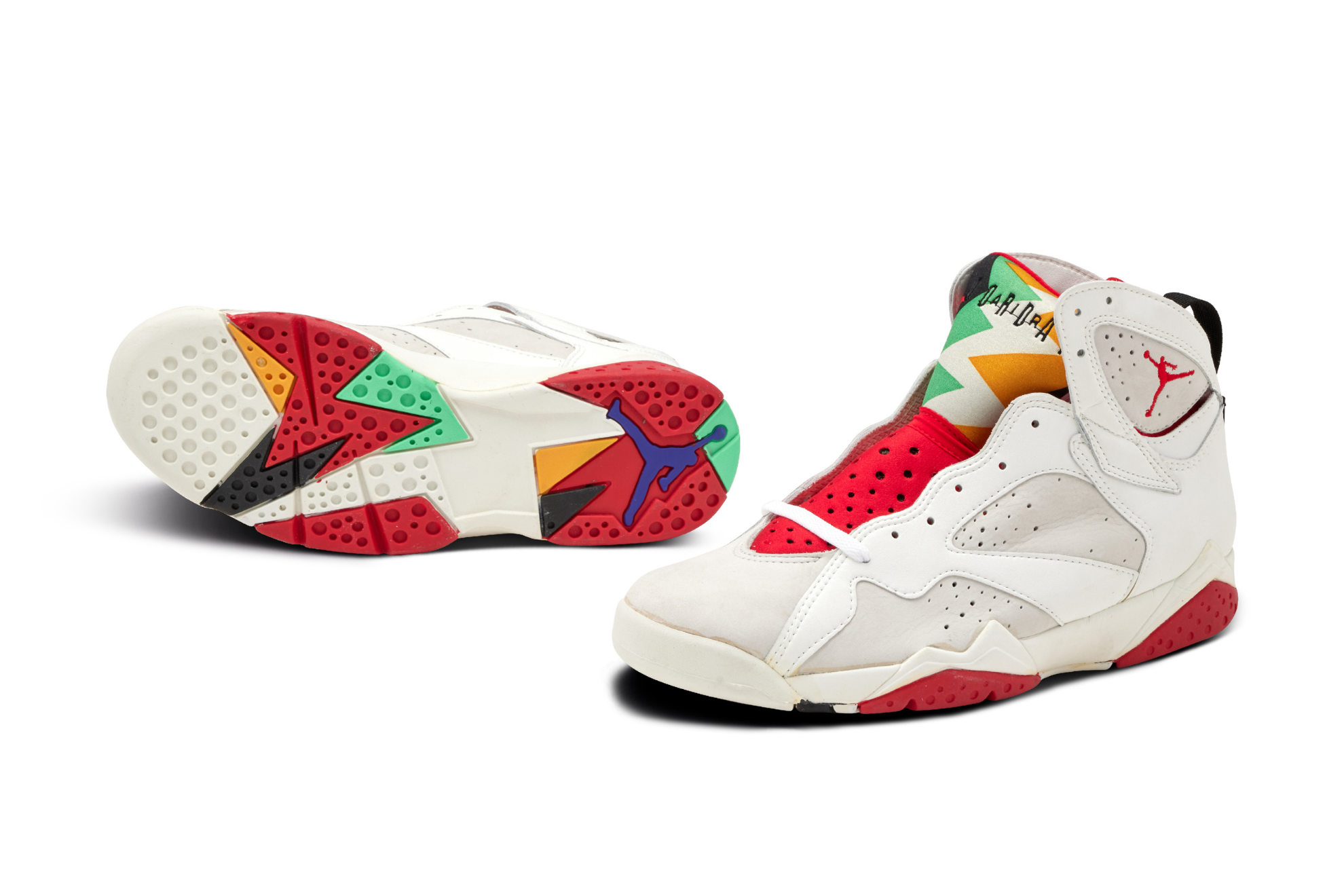
Tinker Hatfield's 7 pulled its neoprene inner bootie from the Nike Air Huarache, which gave it the snug fit players remember, and swapped the 6's visible heel Air for an exposed Phylon midsole. Sneaker Freaker's history notes it was the first Jordan since the 3 with no Nike Air branding at all. The reasoning was commercial as much as aesthetic: by 1992 Jordan was his own entity, and the shoe's geometric tongue and heel graphics, which Hatfield drew from African art and pattern, did the identifying. Grailed's model history puts retail at $125.
The five 1992 colorways each had a job. The Hare was the ad shoe. The Bordeaux was the All-Star shoe. The Olympic was the Barcelona shoe. The Raptor, black with true red, was the playoff shoe. The Cardinal was the one nobody talked about until the retros.
Hare Jordan
Nike bought a minute of Super Bowl airtime in January 1992 and paired Jordan with Bugs Bunny in a spot that blended live footage and 2D animation. Sneaker Freaker's campaign history describes the full push: print ads, Looney Tunes Jordan apparel, posters, then a 1993 sequel and, in 1996, the movie. Jordan wore the Bordeaux 7 in the ad. Bugs wore the white, silver and true red pair that became the "Hare." That is why the colorway exists. It was a cartoon's shoe first.
The 1994 sequel, per Wikipedia's Super Bowl commercial list, had Marvin the Martian steal every Air Jordan on Earth and challenge MJ and Bugs to a game with the planet at stake. Anyone who has seen Space Jam knows where that went. The film was a Nike ad campaign that grew a plot, and the Hare 7 is the receipt.
The number 9
The Olympic 7 carried Jordan's Team USA number 9 on the heel, in gold and silver on a white, navy and red upper. It is the only Jordan that references a number other than 23 or 45, and it commemorates the one summer Jordan played for someone other than the Bulls and Nike. The medal-stand story, the flag over the Reebok logo, is its own piece, but the shoe was in the middle of it: Nike had half of the Dream Team under contract and Jordan on the podium in a rival's jacket.
Bordeaux
Jordan wore the Bordeaux at the 1992 All-Star Game in Orlando and in his cameo in Michael Jackson's "Jam" video, per Grailed. That was the entire on-body record for a colorway that would wait until 2011 for its first retro. The 7's retro timeline, per Sneaker Freaker, ran 2002 (Raptor), 2004 (Olympic), 2006 (LS versions), 2008 (Miro) and 2010 (Bin 23), with the Bordeaux, Hare and Olympic cycling back through the 2010s. The next chapter for the model's neighbors is already booked: a Knicks 8 this December and a Charcoal 9 for 2027.
The take
The 7 is the first Jordan sold on entertainment rather than equipment, and it is worth noticing who the entertainer was. Nike, Wieden's agency and Warner Bros. built a franchise on a Black athlete and a white-owned cartoon, and the cartoon got equal billing on the shoe. Space Jam made hundreds of millions and still moves product every retro cycle. Jordan got his cut through Nike. The kids who wore Hare 7s in 1992 got a shoe with no Air in it and a rabbit on the ad. It is still one of the best-looking Jordans ever made, and the honest reading is that the marketing, not the tech, is what they were paying for.
Sources
- A Brief History of the Air Jordan 7 — Sneaker Freaker
- Jumpmania: The Best Air Jordan Marketing Campaigns in History — Sneaker Freaker
- Jordan VII History — Grailed
- List of 1990s Super Bowl commercials — Wikipedia