
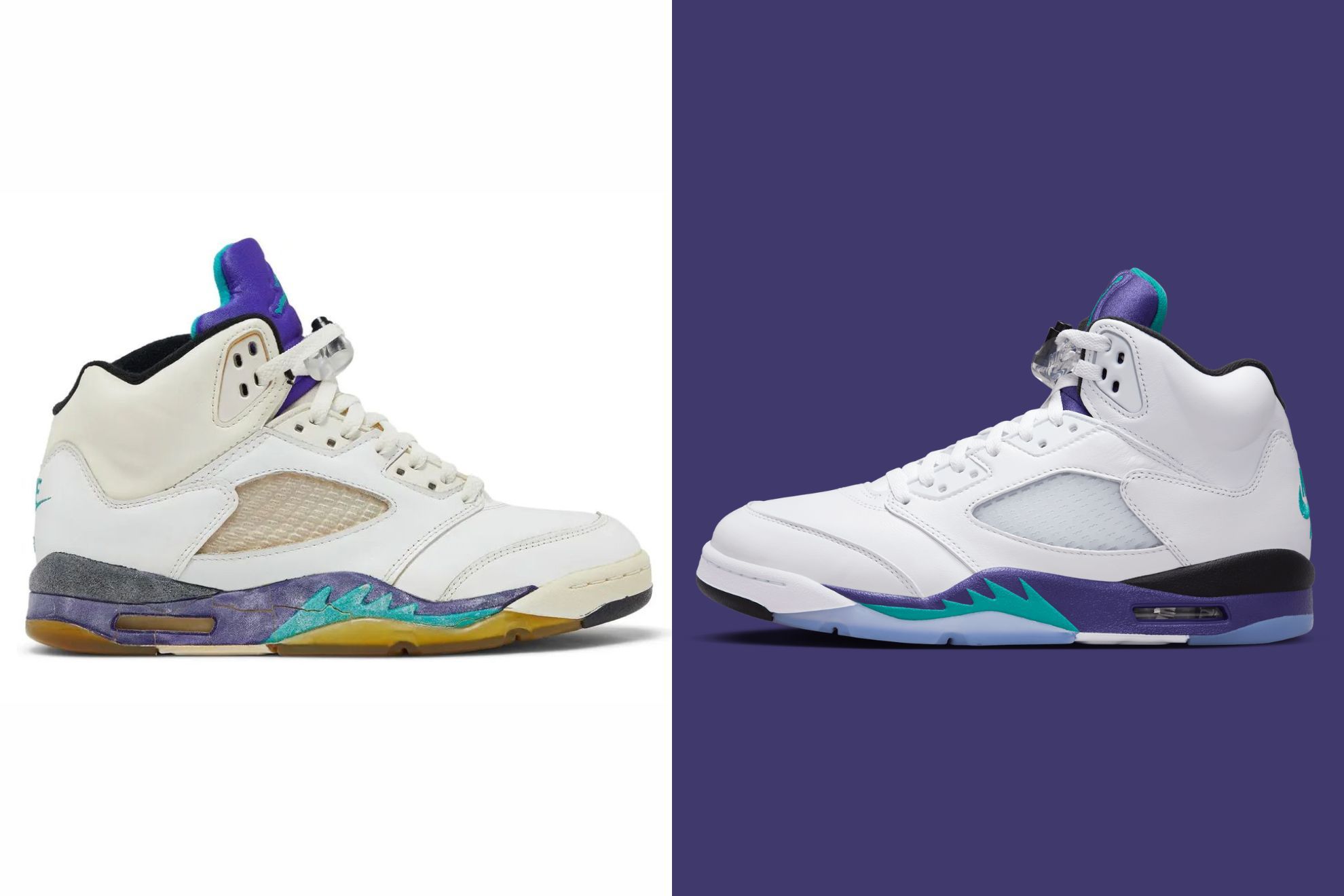
The Air Jordan 5 is the shoe where Tinker Hatfield stopped designing a basketball sneaker and started designing a weapon. The 4 had been a refinement of the 3; the 5, released in February 1990 at $125, was a break. It had teeth on the midsole, a tongue that lit up under a camera flash and a sole you could see through. Every one of those ideas was stolen from somewhere outside basketball, and every one of them has been a headache for Jordan Brand's retro department ever since.
The shark mouth
The story is well worn but the detail matters. Hatfield took the shark-mouth nose art painted on World War II P-51 Mustang fighters and ran it down the midsole as a jagged row of teeth. What gets skipped is that he reversed the direction of the teeth. Sneaker History ties that choice to conversations Hatfield had with Jordan about going one way while everyone else went the other. Will Smith, who wore the shoe in the opening credits of a sitcom that premiered the same year, later told Andscape that nothing else on shelves looked like them in 1990. He was right. The 5 was the first Jordan that looked aggressive standing still.
The four launch colorways told the same story from different angles. Grailed's model history lists them as White/Black, Black/Metallic, White/Fire Red and White/Grape. Jordan wore the Fire Red and the Black Metallic on court. The Grape was a Wheaties-box and Fresh Prince shoe. The White/Black stayed in the background for a decade until the resale market decided it was the connoisseur pick.
The tongue and the sole
The two features that made the 5 different are also the two that cost the most to reproduce. The tongue was 3M reflective material that Hatfield pulled from Nike running footwear, where it existed to keep joggers visible to cars. On a basketball shoe it existed for a different reason: courtside photographers. Sneaker History quotes the logic plainly: a camera flash turns the tongue into a light. Every Jordan wearing the 5 in a 1990 game photo has that silver flare at the ankle, and it is the reason the shoe looks the way it does in the culture's memory.
The clear rubber outsole came from Hatfield's work on the Nike Mag for Back to the Future Part II, and it introduced a problem the industry still has not solved: clear rubber yellows. UV, air, time in a box, it does not matter. A 1990 pair with a still-icy sole is a museum object. That yellowing is why the 2013-era retros got a pass on their tinted soles and why a "pristine" 2025 pair is a thing people write about.
Which retros kept the tongue
This is where the record gets messy, and where the 5 becomes a case study in how Jordan Brand handles its own archive. The reflective tongue was standard on the originals. On retros it became optional, then rare, then a selling point. The 2020 Fire Red is catalogued on the resale platforms as the "Silver Tongue" pair precisely because the reflective tongue had become the exception. Hypebeast covered that release, DA1911-102 at $200, as the third retro of the colorway after 2000 and 2013, and noted it restored both the red Nike Air heel and the hi-vis reflective tongue. It was timed to the 30th anniversary of Jordan's 69-point game against Cleveland on March 28, 1990.
The Nike Air heel has its own timeline. Grailed notes the 2018 laceless "Fresh Prince" 5 was the first pair to carry Nike Air branding on the heel since 1990. Before that, every retro since 2000 had a Jumpman where the original had Nike Air. That is 18 years of the brand selling a shoe with the wrong logo on the back, and people bought it anyway.
Then there is shape. Sneaker Freaker broke down the June 2025 Grape against a 1990 pair and found Jordan Brand had completely retooled the toe box and shape to better reflect the original, with true-to-OG colorblocking and the Nike Air heel. That is the most honest 5 the brand has made in decades, and it took 35 years and a reissue calendar built around anniversaries to get there. The fall slate keeps the model busy, from the glow-sole Halloween 5 to the women's Sunset, and a Black Cat is on the 2027 calendar. Look at each one's tongue before you decide whether it is a 5 or a costume of one.
The take
Hatfield built the 5 out of parts that belonged to other products: fighter-plane nose art, running-shoe safety trim, a movie prop's sole. That mash-up is the same instinct that made hip-hop out of other people's records, and it is why the 5 landed so hard in Black neighborhoods in 1990. The difference is who owned the outcome. Nike kept the mold, the trademarks and the retro schedule, and for most of the last 26 years it sold a version of the shoe with a cheaper tongue and the wrong heel logo to the same community that made it matter. The 2020 Fire Red and 2025 Grape prove the brand always knew how to make it right. It just needed a reason to spend the money. Buy the ones with the tongue.
Sources
- Air Jordan 5: Fighter-Jet Teeth and a Clear Sole — Sneaker History, 2026
- A History of the Air Jordan V — Grailed
- Air Jordan 5 "Fire Red" 2020 Release Date & Info — Hypebeast, March 2020
- Breaking Down the Differences: Air Jordan 5 'Grape' 2025 vs 1990 — Sneaker Freaker, June 17, 2025
- How 'The Fresh Prince of Bel-Air' and 1990s Black television made the Air Jordan 5 'Grape' — Andscape, June 16, 2025