The Air Jordan 6 Black Infrared is the first championship shoe, and it is also the clearest record of how Jordan Brand thinks about its own past: as a product line, not a document. Five retail retros and one resurrected sample later, the question every collector asks is the same one they asked in 2000. Which one is actually the shoe?
June 1991
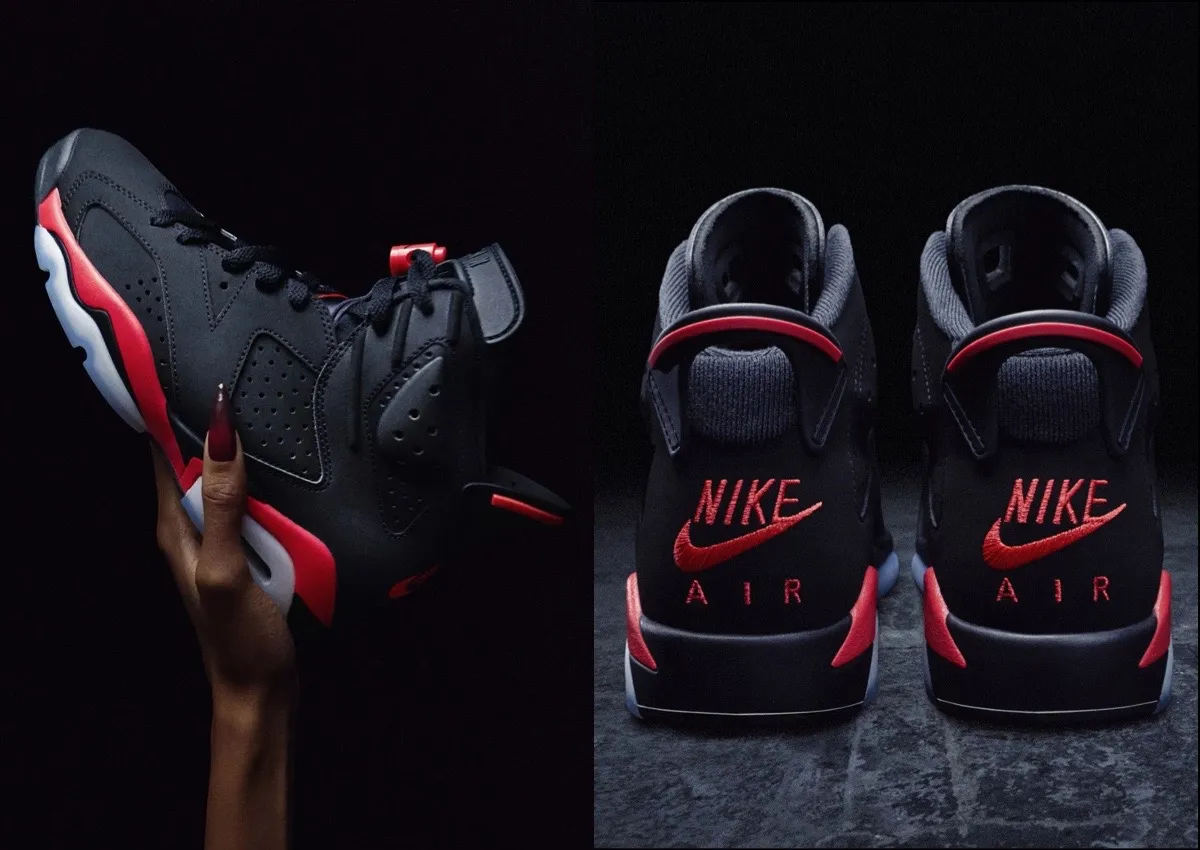
Jordan wore the Black Infrared through the 1991 playoffs and the Finals against the Lakers, where Highsnobiety puts his line at 31.2 points, 11.4 assists and 6.6 rebounds per game. Tinker Hatfield's design borrowed its lines from a Porsche 911, but the details that define the OG are smaller than that. Per the SneakerFiles comparison by Brian Betschart, the 1991 pair had a nubuck upper, a Jumpman-and-Nike-Air lace lock, a Nike Air heel logo with reflective detailing, and an Infrared that was a specific fluorescent red-orange, not a varsity red.
The retro record
The 2000 retro came in August at $120, nine years after the original, and Sneaker News remembers a mature buyer base that treated it as history rather than hype. It kept the Nike Air heel but lost the reflective hit, changed the midsole to a deeper Infrared and dropped the lace lock to a plain Jumpman.
2010 is where the damage happened. Jordan Brand released two versions: a "Varsity Red" pair with a Jumpman heel that split collectors, and an "Infrared Pack" of two pairs at $310 that hit the U.S. in June after an Asia-first run. Both used the Jumpman on the heel. The 2014 Black Friday retro, which Sneaker News called the pick of that year's litter, brought reflective detailing back and used a shade the brand called "Infrared 23," but again with a Jumpman heel. That was the version most people under 30 grew up thinking was the shoe.
The 2019 retro, 384664-060, released February 16 at $200, was the correction. SneakerFiles lists the restorations: Nike Air heel, Jumpman-and-Nike lace lock, proper Infrared, reflective heel, nubuck upper, PU sockliner. For six years that was the answer to the question.
2026 changed the question
On January 16, 2026, Nike announced the Air Jordan 6 "Infrared Salesman," a 1999 prototype that appeared in a seasonal preview catalog and was shelved for almost 30 years. It spread the Infrared across most of the midsole instead of confining it to heel and toe, kept the visible heel Air, raised the tongue 2mm to match game-worn pairs and modified the toe shape closer to 1991 specs. It released February 14, 2026, style code CT8529-001, in packaging built to look like a look-see sample.
That release matters beyond the colorway. Jordan Brand now openly ships toe shapes and tongue heights measured against game-worn pairs, which means every earlier retro was, by the brand's own admission, approximately right. The Sport Blue 6 coming back with Nike Air in fall 2027 is the same policy applied to the next colorway.
So: 2014 if you want the shoe you remember. 2019 if you want the shoe Jordan wore. The 2026 Salesman if you want the shoe Nike almost sold in 1999 and the most accurate tooling the brand has produced. None of them are the 1991 pair, and the brand is finally saying so.
The take
The Infrared 6 is the one Jordan retro that commemorates an actual achievement rather than a movie or a sitcom, and it is the one Jordan Brand got wrong most often. Twenty years of Jumpman heels on a shoe that never had one is not a design choice, it is a cost decision, and the buyers who kept paying were mostly Black and mostly not asking for a refund. The 2019 and 2026 pairs are proof the archive was always available. What changed was the market's willingness to pay $200-plus for accuracy. Reward the accurate ones and the brand will keep making them.
Sources
- Air Jordan 6 Infrared Comparison 1991, 2000, 2010, 2014, 2019 — SneakerFiles, February 1, 2019
- A Look Back At the Six Different Infrared 6s — Sneaker News, November 25, 2014
- A Never-Released Air Jordan 6 Infrared Makes Its Debut — Nike, January 16, 2026
- The 6 Sneakers Michael Jordan Wore When He Became a Champion — Highsnobiety, March 28, 2025