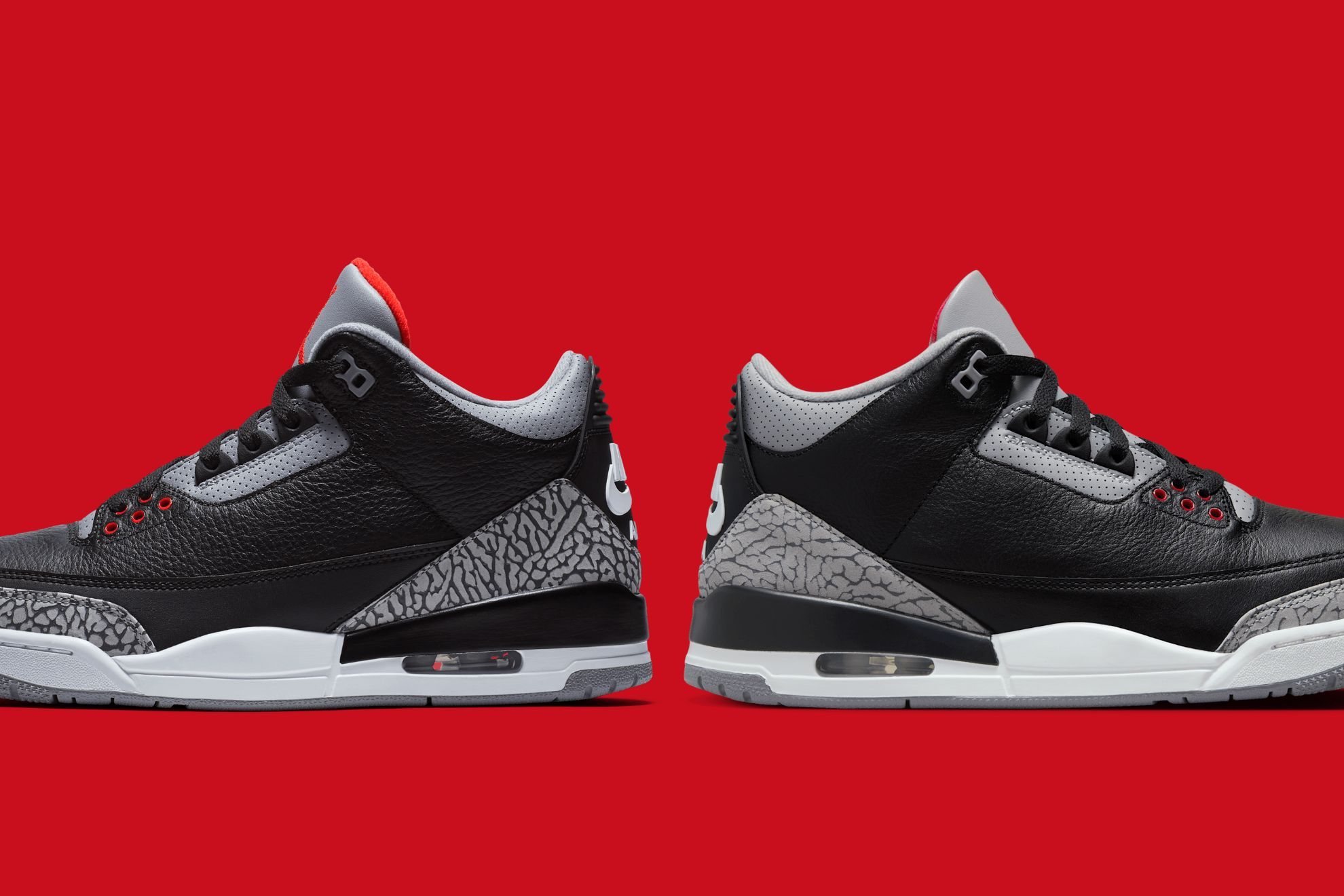
The Black Cement 3 has been retroed five times since 1994 and none of them are the same shoe. The heel logo flipped from Nike Air to Jumpman and back. The elephant print changed density. The leather went from tumbled to pebbled to smooth. The shape drifted away from 1988 and then, in 2024, drifted back. Collectors treat the question of which one "got it right" as taste. It's a paper trail, and the paper says Jordan Brand only committed to accuracy once the resale market told it to.
1994 and 2001: the retro before retros
The 1994 pair was the first Black Cement retro and, per Sneaker Freaker, it didn't land. The market wasn't buying nostalgia while Jordan was retired. The 2001 pair was the successful return, and Brandon Richard's Complex history confirms the detail that defines the next seventeen years: no Nike Air on the heel. Jordan Brand had been spun out of Nike as its own division in 1997, and the Jumpman heel was the corporate signature. The 2001 Black Cement is the pair most people over 35 actually wore, and it's a Jumpman shoe.
2008 and 2011: the Countdown Pack and the leather problem
The 2008 pair came in the 23rd-anniversary Countdown Pack, boxed with the Air Jordan 20. The 2011 pair is the one Sneaker Freaker flags for "inferior leather quality," and Nice Kicks' side-by-side of 2001, 2008 and 2011 documents the drift in real time: elephant-print pattern variances, collar perforation differences, insole and hue changes across three shoes that were sold as the same colorway. None of them carried Nike Air. All of them were sold at retro prices that climbed with each cycle.
The 2011 pair still commanded a 134 percent premium over retail with an average resale of $374 on StockX by early 2018, per StockX. The market didn't punish the leather. It punished scarcity, which is a different thing.
2018: Nike Air comes home
Style 854262-001 released February 17, 2018, All-Star Weekend, and it was the first Black Cement since 2001 to wear Nike Air on the heel, per Complex. It was also the first sold with the "OG" designation. StockX's pre-release data showed the 2018 pair "accounting for 10.7% of Jordan 3 dollars spent" before it had even dropped, and it briefly out-sold the Blue Tint Yeezy 350, ending a 45-day run at the top of the platform. Post-release, the average resale settled at $283, a 42 percent premium. Wider stock, lower premium, more accurate shoe. That's the trade Jordan Brand made, and it's the one that actually serves the people who wear them.
2024: the reshape
The November 2024 pair went further. Sneaker Freaker's comparison lists a silhouette updated "to better reflect that of the 1988," a lighter grey on the print and accents than the 2018's darker tones, and "smooth and supple leather" replacing the 2018's more textured, pebbled hide. The Nike Air heel stayed. If the 2018 fixed the branding, the 2024 fixed the body.
The verdict
The 2018 is the most important retro because it ended the Jumpman era on this colorway and proved the brand could sell accuracy at volume. The 2024 is the most accurate. The 2001 is the most worn. If you want the shoe Jordan dunked from the line in, the 2024 is closest; if you want the shoe that changed how Jordan Brand thinks about its own catalog, it's the 2018. The 2011 is the one to avoid at collector prices: it carries the worst leather of the run and the wrong heel, and its premium is a function of the six-year gap that followed it, not the shoe.
The take
For seventeen years, Jordan Brand sold Black Cement 3s with the wrong heel to a Black consumer base that kept buying them, because the alternative was nothing. The Jumpman-heel era wasn't a design choice. It was a corporate one: a division asserting its own logo over the parent's, at the expense of the shoe's history, on the strength of a customer who would pay regardless.
The Nike Air return happened when resale data made accuracy profitable. StockX's numbers on the 2011 pair are the receipt: a shoe with worse leather and the wrong logo earning a 134 percent premium told Beaverton exactly how much room it had. The 2018 and 2024 pairs are better shoes. They're also the brand pricing in what its customers had been telling it, for free, since 2001.
## Sources - Breaking Down the Differences Between the 2018 and 2024 Air Jordan 3 'Black Cement' — Sneaker Freaker, November 22, 2024 - A Video Comparison of 'Black Cement' Air Jordan 3 Retros — Complex, February 3, 2018 - Air Jordan 3 Black/Cement 2001, 2008 & 2011 Comparison — Nice Kicks, July 26, 2011 - Air Jordan 3 Black Cement 2018 Release: How Will It Sell — StockX, February 9, 2018