Three Air Jordan 1s did more for Nike's balance sheet in three years than any ad campaign since "Banned," and Nike sold almost none of them at the price that mattered. Off-White's Chicago 1 (October 27, 2017, $190). Travis Scott's Mocha (May 11, 2019, $175). Dior's Air Jordan 1 High (summer 2020, $2,200). The retail price on each was a formality. The resale price was the product, and the gap between the two, thousands of dollars a pair paid to resellers rather than Nike, was the most efficient marketing spend in the company's history, because Nike did not spend it.
Virgil: the Chicago that started it
"The Ten" landed in late 2017 in two waves, and the Air Jordan 1 "Chicago" (AA3834-101), released October 27, 2017 at $190, was the anchor. Highsnobiety's resale analysis tracked it averaging $2,019 on release and peaking at $2,339 by May 2018. A 10x premium on a Jordan 1 was new. Virgil Abloh's deconstruction, the exposed foam, the zip tie, the Helvetica "AIR" on the midsole, gave the design world a reason to care about a basketball shoe, and gave every reseller with a bot a reason to care about Nike's release calendar. When Abloh died on November 28, 2021, Hypebeast reported the Chicago jumping to $5,300 to $10,000 within hours. Grief, priced in real time, on a platform that takes a cut.
Travis: the backwards Swoosh
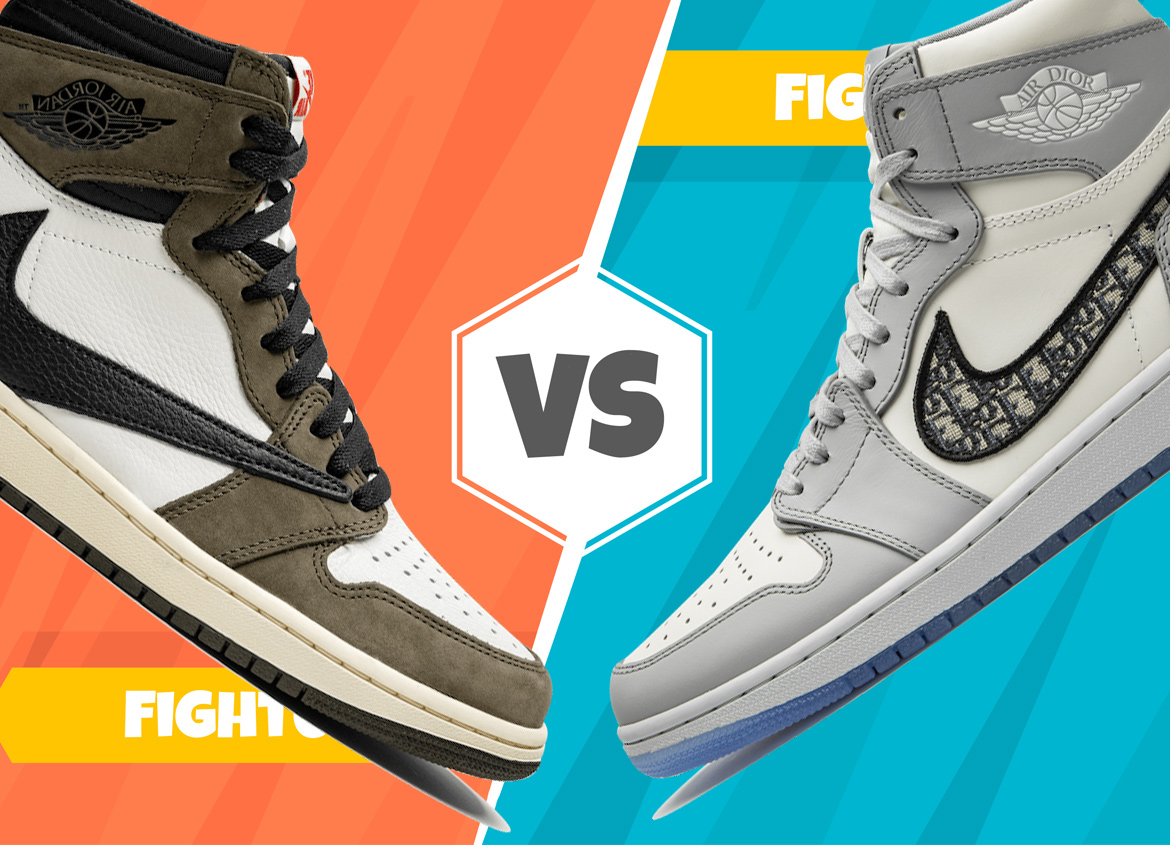
Travis Scott's Air Jordan 1 High OG "Mocha" (CD4487-100) released May 11, 2019 at $175, per Sneaker Bar Detroit, with the reversed Swoosh, brown suede, a stash pocket in the collar and Cactus Jack branding. It became the most-traded Jordan 1 on the resale platforms and stayed above $1,000 for years. The design was modest compared to Virgil's; the demand was about Travis. Houston's biggest rapper had a shoe that Houston could not buy at retail, which is the exact tension Nike has learned to farm. The red Chicago low reported for 2027 is the same play, seven years on.
Dior: five million entries
The Dior x Air Jordan 1 was the ceiling. Kim Jones' Dior Men collection put the Jumpman on a Dior-monogrammed Jordan 1, made in Italy, and priced it at $2,200 for the high and $2,000 for the low. Complex reported that five million people registered for a chance to buy, a figure Dior's CEO Pietro Beccari confirmed to WWD, against roughly 8,000 pairs of each cut, with 5,000 pairs reserved for Dior's top clients. Five million people entering a raffle for a $2,200 shoe is a marketing event that a Super Bowl ad cannot buy. Nike's cost: a license. Dior's cost: the shoes. The customer's cost: the entry, and then a resale price at multiples of retail for the ones who lost.
The subsidy
Here is the mechanism. Nike sells a collaboration at retail, which is the low number. Resellers sell it at market, which is the high number. The high number is what the press reports, what the culture argues about and what makes every non-collab Jordan 1 look reasonable at $180. The premium is a marketing expense that Nike does not pay, because the reseller pays it, the buyer pays it and StockX and GOAT take a fee on both. Nike gets the headline, the halo and the next general-release colorway sold at full price to people who missed the raffle. The Off-White Chicago cost $190 and generated $2,000 worth of attention per pair; the Dior generated $2,200 in retail and five million names in a database. The resale market is not Nike's enemy. It is an ad agency that works on commission and never sends an invoice.
Who got paid
Virgil got a Louis Vuitton job and a legacy. Travis got a Cactus Jack business and a stash pocket. Dior got a sneaker customer. The resellers got the premium. Nike got everything downstream: the Jordan 1 became the most-produced retro in the catalog, the brand doubled revenue between 2020 and 2024 before the market cooled, and the Jumpman was welcomed into fashion week without the company buying a runway. The people who lined up, entered the raffle, and lost are the ones who funded it, with attention and then with resale dollars. That is the Black consumer's role in the fashion-week Jordan: demand engine, then customer of last resort.
The take
The collab Jordan 1 is the clearest illustration of extraction in the modern sneaker business. A Black designer, a Black rapper and a French house each put their name on a shoe from 1985, and the surplus flowed to a marketplace and a corporation. Abloh and Travis at least got to author theirs. The kid who paid $2,000 on StockX got a shoe, a screenshot and a reason to buy the next one. Nike got the ad, free, and a resale market that has been doing its job since. When the brand says it wants to fight resellers, ask which side of the ledger the premium sits on.
## Sources - The Complete Guide to Every Off-White x Nike Release — Highsnobiety, 2018 - Off-White x Air Jordan 1 "Chicago" Resale Prices Skyrocket — Hypebeast, November 29, 2021 - Travis Scott Air Jordan 1 High OG "Mocha" 2019 CD4487-100 — Sneaker Bar Detroit, May 31, 2026 - 5 Million People Tried to Buy the Dior x Air Jordans — Complex, July 3, 2020