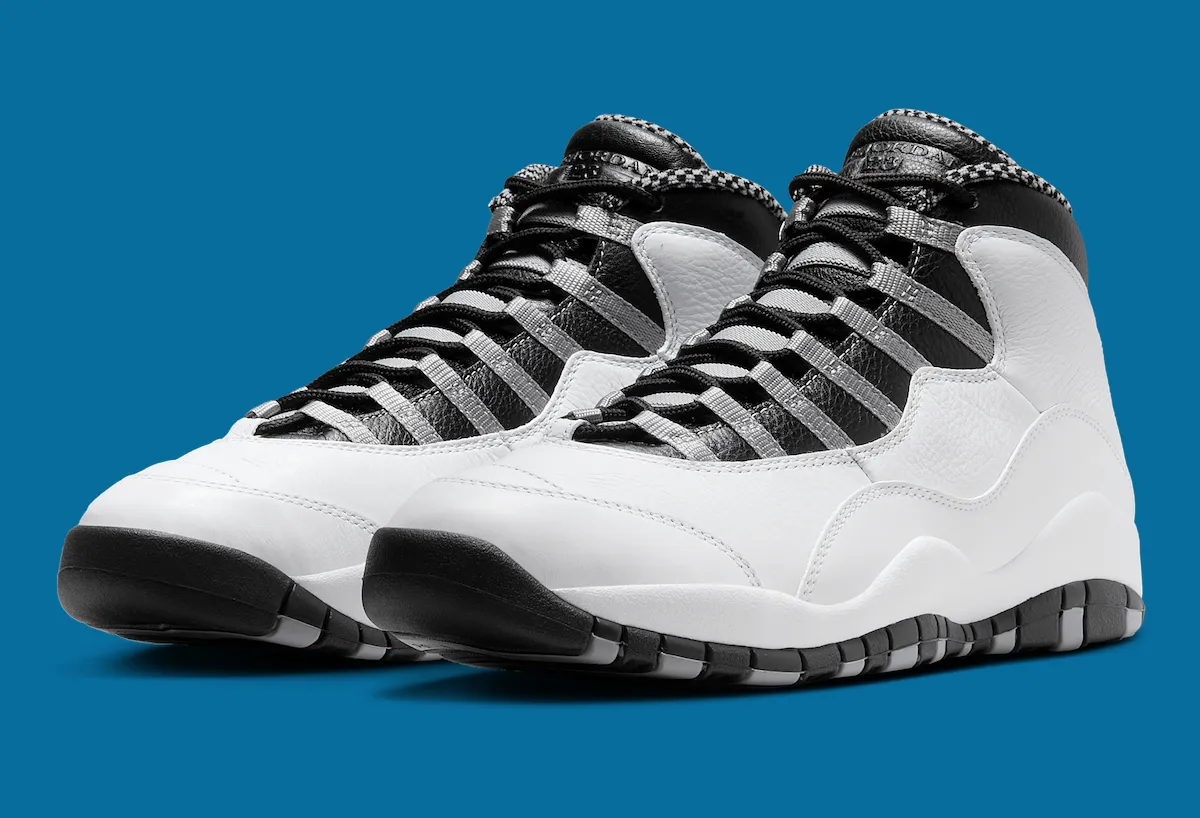
The Air Jordan 10 is the only shoe in the line that was designed as an obituary. When Tinker Hatfield sat down to draw it in 1993, Michael Jordan had retired, his father had been murdered, and Nike's most valuable athlete was in a Birmingham Barons uniform chasing curveballs. Hatfield's answer was a tribute: a clean white leather shoe with ten grooves on the outsole, each one stamped with a year and a milestone from 1985 to 1994. It was a career summary molded in rubber. Then the subject of the eulogy walked back into the building.
A shoe nobody was supposed to play in
The 10 arrived in the fall of 1994 without its namesake on an NBA floor. Jordan was, in his own words, focused on baseball, and the shoe was worn by the rising class Nike had lined up to carry the Jumpman in his absence. Sneaker Freaker describes the "Steel" as the tribute shoe with "10 lateral stripes on the sole, each representing Michael Jordan's 10 early career milestones," and Hatfield's stripped-down build, which dropped the visible Air of the 3 through 6 and the wild straps of the 8, read as a deliberate calming of the line. The only time Jordan actually laced the Steel in anything resembling competition was Scottie Pippen's Ameritech All-Star Classic at Chicago Stadium on September 9, 1994, where he dropped 52 in 48 minutes in a charity game, per Andscape.
He did not love it. Andscape's Ian Stonebrook pulled Jordan's own line on the original: "It wasn't consistent with the way I thought the shoe should look." The problem was the toe cap, the leather overlay across the front that Jordan thought looked clunky. Nike listened. Later retros of the Steel removed it, and the 2025 return (HJ6779-104, August 2, 2025) was the first retro since 2013 to put the toe cap back, packaged in the 1994 box. It took three decades for the brand to decide the thing Michael hated was the thing worth preserving.
The city pack: Nike hedges its bets
The five-city collection is the tell for what Nike was really thinking. With no Jordan, the brand cut the 10 into regional editions: Chicago, New York, Orlando, Sacramento and Seattle. Every pair shared the white leather upper and black midsole, then split on lining and outsole color. House of Heat lays out the split: red for Chicago, royal blue and orange for the Knicks, Magic blue and black for Orlando, purple for Sacramento, green and gold for the SuperSonics.
Read that as a marketing document. In 1994 Nike was already treating the Jumpman as a brand that could outlive the player, and the city pack was a test of whether local team colors could sell a Jordan without Jordan. Sacramento got a purple pair because Mitch Richmond was a Nike guy on a Nike-friendly roster; Seattle got green and gold because that Sonics team was must-see. Sneaker Files notes that Sacramento even had a player-exclusive white version that never hit retail, which is why that pair has stayed the ghost of the set. Jordan Brand only got around to a first retro of it in 2026, a story already on The Lane, and the Knicks version has waited even longer, with a retro finally reported for fall 2027.
March 1995: the eulogy becomes a comeback shoe
The fax went out on March 18, 1995. Two words. Jordan suited up the next day against Indiana in number 45, since the Bulls had retired 23, and the NBA says the return drew an estimated 35 million viewers. He scored 19 in an overtime loss. Three games later he went to Madison Square Garden and hung 55 on the Knicks, capping it with the pass to Bill Wennington for the winning dunk. The shoe on his feet was the Chicago 10, the red-lined city-pack pair, with a 45 stitched on the collar.
That is the accidental genius of the 10. A shoe built to close the book got the first chapter of the second act instead. The outsole still ends at 1994, which means every Chicago 10 on the market carries a career summary that was wrong the moment it was worn. The Double Nickel retro trades on that mistake, and collectors pay for it precisely because the milestone list stops short.
Where the money went
Nike's revenue did not stop when Jordan stopped. The Air Jordan line kept shipping through the retirement on the strength of the 9 and 10, the Team Jordan players, and city-specific product that let Foot Locker sell a Bulls shoe in Sacramento. The 10 proved the Jumpman could carry a season without a highlight to attach to it, and that lesson is the foundation of everything Jordan Brand became after the 1997 spin-off: a business that sells the memory of Michael to people who never watched him play.
The take
The Steel was Hatfield's honest attempt at a goodbye, and the city pack was Nike's honest attempt at a hedge. Both were made on the assumption that the Black athlete at the center of the enterprise was done, and both were designed to keep the checks clearing without him. He came back, made the outsole a lie, and the brand has spent thirty years selling the lie at a premium. It is a good shoe and a better lesson: the machine was always built to run without the man.
## Sources - Revisiting the 'Steel' Air Jordan 10 — Andscape, July 28, 2025 - Back Like MJ in '95: The Air Jordan 10 'Steel' — Sneaker Freaker, July 21, 2025 - Celebrating 30 Years of the Air Jordan 10 "City Series" — House of Heat, July 27, 2025 - Remembering the Original Air Jordan 10 'City Pack' — Sneaker Files, May 11, 2016 - Legendary Moments: Michael Jordan returns to the NBA — NBA.com